 Skip to content
Oil-Based vs. Penetrating Stains: Decoding the Label for Premium Fence Staining and Restoration
As a discerning homeowner, you understand that your fence is a significant investment. When it comes time for professional fence staining, selecting the right product is the most critical decision for protecting your property’s value and aesthetics.
We’re often asked about the difference between traditional surface coatings (which we call “film-formers”) and the superior penetrating oil stains we use, like the ultra low VOC pet friendly Expert Stain & Seal. The difference comes down to science—and knowing how to read the can.
Here is an expert guide to help you differentiate these two categories and ensure your fence gets a long-lasting, quality finish.
The Film-Forming Flaw: Why Some Stains Are Prone to Peeling and Why We Shy Away From them… You should too!

Traditional, heavy oil-based stains or many general-purpose acrylic/latex stains are known as film-formers. Their formula is designed to create a thick, protective shell that sits on top of the wood.
➕ Initial Appeal of Film-Formers
Deep Color: They offer very rich, opaque colors in one coat.
Hard Surface: They feel hard and glossy initially, creating a strong moisture shield.
➖ The Major Drawbacks (The Peeling Problem)
Cracking and Peeling: When exposed to sun and temperature swings, the hard film is rigid. The wood underneath expands and contracts, but the film doesn’t, causing it to crack, bubble, and peel.
Trapped Moisture: The thick film can trap moisture inside the wood, leading to mildew, rot, and premature deterioration.
Expensive Maintenance: This is where the hidden costs lie. Once peeling occurs, the fence requires aggressive stripping or sanding before any future fence staining. This can cost 2-3 times what it cost you to stain the fence in the first place.
How to Differentiate: Decoding the Stain Label
The difference between a peeling stain and a penetrating stain comes down to the binder (the glue) and the overall volume of solids. When choosing a product, look for these tell-tale signs:
1. The Binder/Resin Type (The “Glue”)
The binder holds the pigment and solidifies the protective layer. The type of resin is the most important clue to how the stain performs.
| Telltale Film-Forming Resin | What It Means | The Penetrating Counterpart |
| Acrylic or Latex | These polymers are designed to form a hard, plastic film on the surface. They coat, they do not soak. | Oil/Alkyd resins designed to be low-molecular-weight and thin enough to saturate the wood deeply. |
| Polyurethane | This is a clear top-coat finish. If it’s prominently featured, it’s designed for surface durability and is a film-former. | Oil-Rich, Low Solids formulas that condition the wood from within. |
Pro Tip: If a can is labeled “Solid Color Stain,” it usually contains very high amounts of these film-forming resins, making it behave almost identically to paint.
2. High Volume of Solids
“Solids content” refers to the material left on the wood after the liquid carrier evaporates.
Telltale Sign: The product label or technical sheet lists a very high percentage of “Volume Solids” (e.g., $40\%$ or more).
Why it Forms a Film: This means there is too much material to be absorbed into the wood fibers. The excess is forced to build up on the surface, creating that peel-prone layer.
The Modern Standard For Cedar Privacy Fences In Oklahoma: Advanced Penetrating Oil Stains
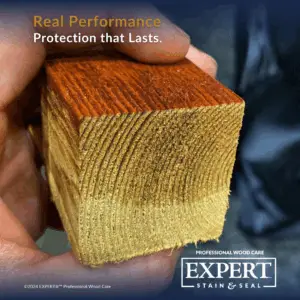
We specialize in advanced penetrating oil stains because they are engineered to be absorbed deeply into the wood fibers, conditioning and protecting them from the inside out.
The Unmissable Clues of Quality Penetration
Look for Phrases: “Deep Penetrating,” “Oil-Rich,” or “Low Viscosity.”
Absence of Film-Formers: The front of the can will not heavily feature Acrylic, Latex, or Polyurethane.
➕ The Superiority of Penetrating Oil Stains
True Protection: They shield the wood from UV and moisture damage while allowing it to breathe. This prevents the internal rot and mildew common with film-formers.
Flawless, Easy Re-Coating: When it’s time for maintenance fence staining (typically every 3-5 years), there is no stripping required. The stain slowly fades, so we simply perform a professional fence cleaning and apply a fresh coat.
Zero Peeling: Since the stain is absorbed into the wood and doesn’t rest on the surface, it is impossible for it to peel or bubble.
For the discerning homeowner who demands quality, longevity, and hassle-free maintenance, advanced penetrating oil stains provide the definitive protection your property deserves.
Ready to protect your investment with professional fence cleaning and superior fence staining materials?
Contact us today to schedule your complimentary property assessment and custom quote!